Blog
Producing FDA Submission-Ready Documents Without Manual Rework

Regulatory automation gets judged on one question. When the document comes back, does someone have to fix it before review can start? A tool that produces a draft requiring a rescue pass has moved the labor and saved nothing. Rework is the hidden cost in most document automation programs, and it shows up as senior authors reconciling abbreviation lists at 9pm the week before a filing deadline.
Submission-ready output sets a higher bar. The mechanics are finished, every change is evidenced, and human reviewers spend their hours on interpretation and approval. Reaching that standard takes orchestration, governance, and a complete audit trail, which is a different build from a single agent running a formatting script.
What Separates a Rough Draft From a Submission-Ready Regulatory Document
A rough draft carries the science. A submission-ready document carries the science and satisfies every mechanical condition a health authority applies before review begins: correct eCTD granularity and file structure, template and style conformance, consistent defined terms and abbreviations, resolved cross-references, clean metadata, and no residual tracked changes or hidden text.
The distinction is enforced. FDA states that submissions not in eCTD format will not be filed or received unless exempted. Format compliance sits upstream of scientific merit, and a dossier with unresolved mechanical defects consumes reviewer goodwill and internal cycle time before anyone evaluates the data.
Submission-ready describes the document's condition. Qualified human reviewers and approvers decide whether it files.
Traceability and Audit Trail as Submission Requirements
Regulators expect the system to record its own work. 21 CFR Part 11 requires secure, computer-generated, time-stamped audit trails covering every action that creates, modifies, or deletes an electronic record. EU GMP Annex 11 sets the same expectation for computerized systems in Europe. The audit trail forms part of the record itself, and a record missing one is incomplete.
Automation makes the requirement harder to satisfy. Every time an agent applies a style rule or reconciles an abbreviation list, the system has to answer four questions afterward. What changed. Which rule made the change. Which version of that rule was in force. Who approved the result. An inspector asking why a section was reformatted in March should find all four answers in the log.
Enterprises are already funding that control layer. 16.7% of planned AI spending goes to AI and agent security and governance, according to IDC, July 2026. The same research puts a number on the downside: by 2030, up to 20% of G1000 organizations will face lawsuits, fines, or dismissed CIOs after losing control of their AI agents.
Where Human Review Belongs Before an FDA or EMA Filing Goes Out
Agents handle mechanics. People handle judgment.
Mechanical work follows fixed rules and returns the same result every run:
- Template and style enforcement against the health authority format
- Abbreviation extraction and reconciliation against the approved list
- Symbol validation and hidden text removal
- Cross-reference integrity after tables and figures get renumbered
- Completeness checks against the submission plan
- Discrepancy reporting back to the author
Regulatory judgment stays with a qualified person: the benefit-risk narrative, interpretation of clinical and nonclinical data, claim language and labeling positions, the strategy behind responses to agency questions, and the final quality control and approval signature.
The consequential decisions sit on the judgment side. 48% of the complete response letters FDA has published cited deficiencies covering both safety and efficacy. FDA released more than 200 of those letters, covering decisions from 2020 through 2024, with the breakdown reported by Applied Clinical Trials, July 2025. Scientific reasoning resolves problems of that kind.
Human-in-the-loop review works best as a designed control point with a recorded approval event. A qualified reviewer opens the document and sees what the agents changed, what they flagged, and what still needs a decision.
How Astra Orchestrator Agents Carry Formatting, Abbreviation Management, and Audit Trail Into Submission-Ready Output
Most agent programs stall before production. Gartner predicts that over 40% of agentic AI projects will be canceled by the end of 2027, driven by escalating costs, unclear business value, and inadequate risk controls. The third driver is decisive in regulated functions.
The APEX Reference Framework for Life Sciences
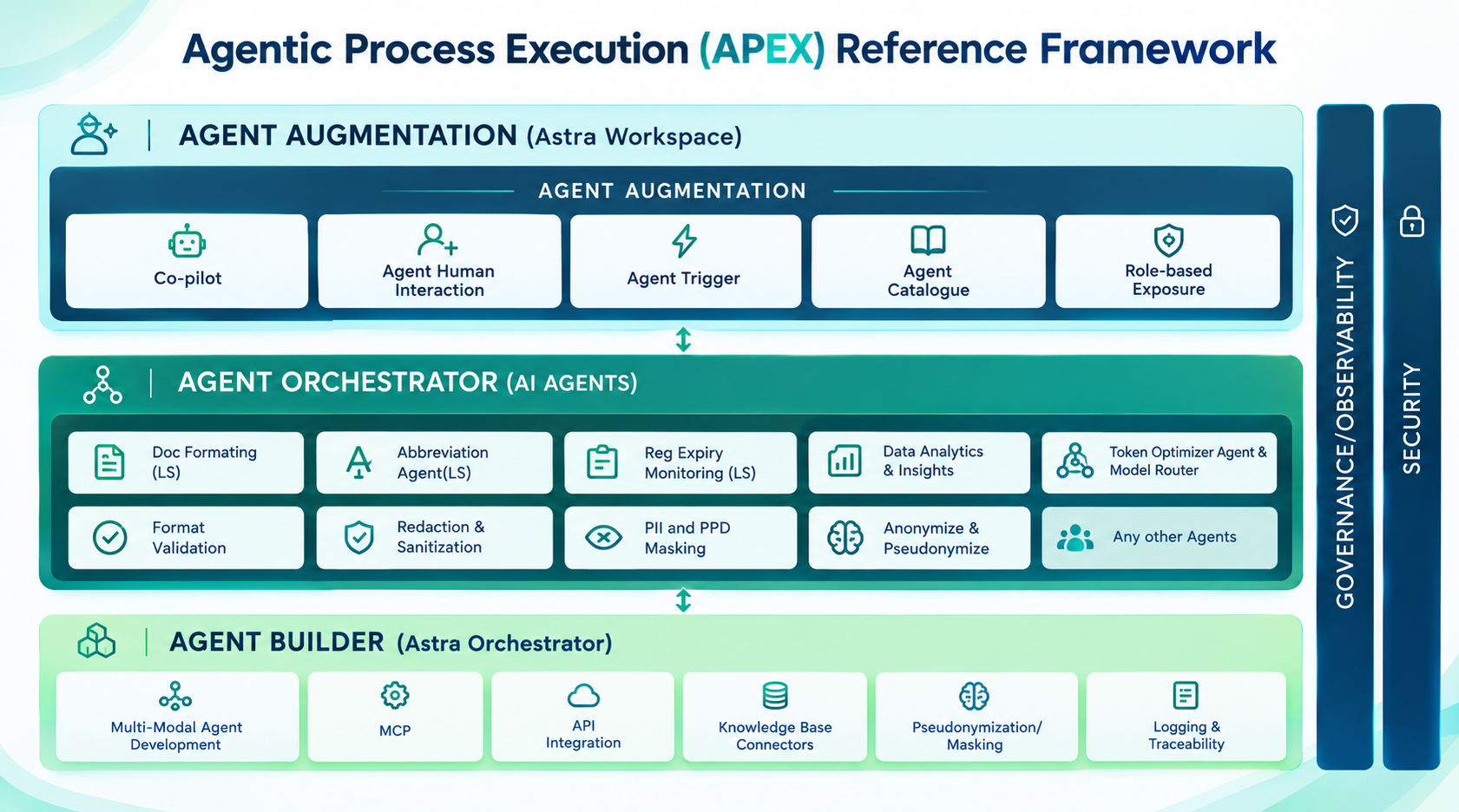
APEX is Amiseq's deployment-ready framework for Agentic Process Execution, built in three layers.
Astra Orchestrator is the build layer, covering multi-modal agent development, MCP, API integration, knowledge base connectors, masking, and logging and traceability. The agent layer holds the working agents. Document formatting, abbreviation management, format validation, and regulatory expiry monitoring are built specifically for life sciences, running alongside redaction, PII masking, and a token optimizer and model router that holds cost predictable. Astra Workspace is the augmentation layer, where people meet the work through a co-pilot, agent triggers, a role-based catalogue, and defined human interaction points.
Governance, observability, and security run vertically across all three layers, which is what turns agent activity into a complete audit trail.
How Agents Move a Regulatory Document to Submission-Ready
Intake pulls the source from the document management system. A formatting agent applies the health authority template and style rules. An abbreviation agent extracts every term in use and reconciles it against the approved list, flagging undefined and orphaned entries. Validation agents clear hidden text, verify symbols, and confirm cross-reference integrity. A reporting agent returns a summary of every change made and every item left unresolved to the author.
Why Orchestration Produces the Audit Trail
Orchestration turns the sequence into one finished document instead of fragments scattered across systems. Governance, observability, and security run underneath each step, which means the audit trail accumulates as the work happens and no one assembles it afterward.
The Cost Case for Regulatory Document Automation
Take a regulatory function producing 3,000 documents a year, each carrying about 3 hours of formatting, validation, and abbreviation work. At a loaded rate of $80 an hour, the mechanical layer costs roughly $720,000 a year. Automating 70% of it returns about $500,000 annually to the function.
Direct savings are the easiest part of the case to calculate. The larger exposure sits downstream. A submission rejected on format triggers a full rework cycle and consumes the same senior hours a second time. A filing delayed past its target window pushes product revenue out by weeks, and in pharmaceutical terms a delayed launch costs well beyond the documents that caused it.
Where to Start With Regulatory Document Automation
The shortest path runs through one document type. Pick the format with the highest volume and the heaviest mechanical burden, put agents on the formatting, abbreviation, and validation work, and measure what reaches the reviewer. Results at that scope make the case for the next document type, with governance and the audit trail already established.
Map the first document type with an Amiseq specialist: amiseq.com/contact
Related Blog

Transformation enabled
While most of the organizations fast track digital transformation, it is essential to consider...

BPA Total Cost of Ownership Video Series
Making sense of the Total Cost of Ownership is a prerequisite for producing above average...

Making Sense of the Total Cost of Ownership – Assessment & Consulting | Development & Deployment
Assessment and consulting costs are the costs of engaging a suitable BPA third-party...